Flora
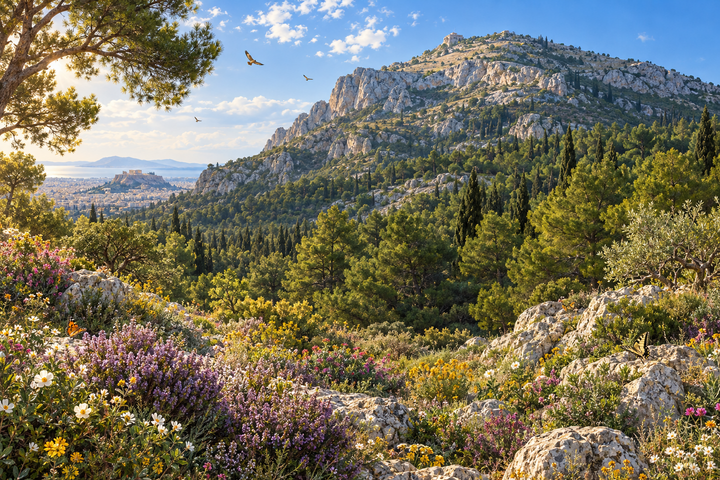
Vegetation on Hymettus changes from north to south and with altitude. According to the Hellenic Ornithological Society, an Aleppo pine forest grew up in the north after the end of the Second World War, thanks to extensive reforestation around Kaisariani. In the central and southern parts pine gives way to evergreen broadleaf shrubland and phrygana, and at 800 to 1,000 metres shrubland dominates.
On the same source’s habitat map, shrubland covers 62.8% of the area, artificial landscapes 15.2%, forest 14.4%, grassland and pasture 5.1% and rocky areas 2.6%. The forest share is small compared with the "green mountain" picture one has from afar.
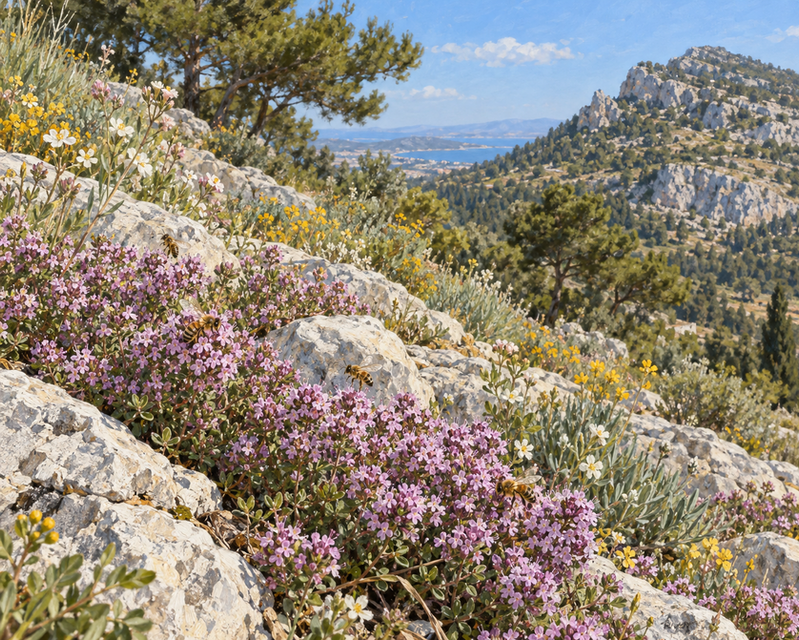
Aromatic plants gave the mountain its fame. Kathimerini reports that the slopes are largely covered by herbs, above all thyme, which made the honey of ancient Attica famous. Pliny the Elder, and Virgil before him, praise thyme honey.
Sources
- Hellenic Ornithological Society, Important Bird Area GR126 Mount Hymettus
- Kathimerini (English edition), "Mt Hymettus", John Leonard, 28 December 2010
- Wikipedia (Greek), Υμηττός
An earlier version of this page gave 654 plant species, 40 Greek endemics and 44 wild orchids. These numbers were not verified in any source opened in this phase and were removed. No open university or Hellenic Botanical Society species list for Hymettus was found.