Geology and rocks
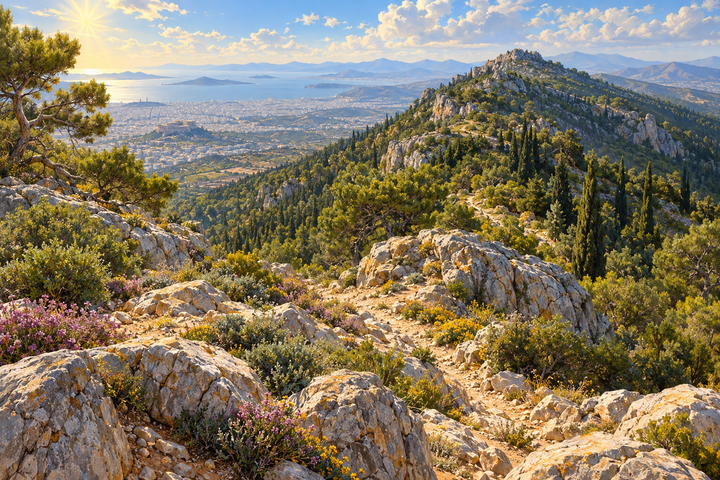
Geologically, Hymettus belongs to the Attic-Cycladic zone. Its rocks include limestone, schist and large masses of marble. Much of the mountain is rocky and treeless, while the forest lies mainly in the north.
According to Greek Wikipedia, the rocks include limestone, schist and large masses of marble and mica schist. English Wikipedia adds that most of the mountain is rocky and limestone, while the forest lies mainly in the north.
Hymettian marble has been quarried since antiquity, with quarries mainly on the west side. According to Kathimerini, it was not as white as Pentelic marble but had a reputation as a luxury material in Augustan times, and Horace and Pliny mention it. After the 1st century BC its use declined, once the Romans found white marble closer to home, at Carrara.
High above the Monastery of Aghios Georgios Koutalas, the same article describes quarry pits and stone shelters now called "dragon houses". Specialists differ on their interpretation but broadly agree they date to the Hellenistic period. Those on Hymettus are the only known examples in Attica.
The slopes also hold caves. The largest is Koutouki cave, above Paiania, and the smaller Liontari cave lies on the eastern side of the mountain, at 550 metres, west of Glyka Nera, according to the Ministry of Culture. Greek and English Wikipedia place it in the north.

Sources
- Wikipedia (English), Hymettus
- Wikipedia (Greek), Υμηττός
- Kathimerini (English edition), "Mt Hymettus", John Leonard, 28 December 2010
The geology here is described in general terms from encyclopedic and press sources. No university geological study was found and opened, so no rock ages or zone details are given.