
Monasteries and churches
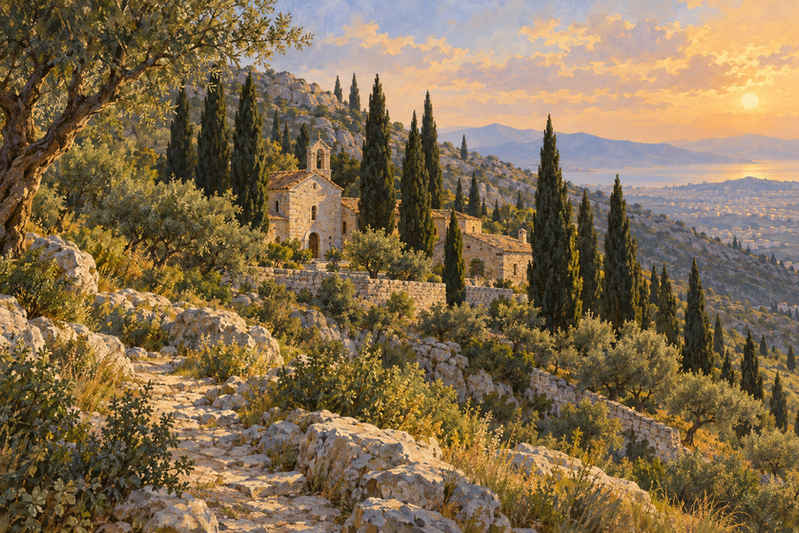
Kaisariani Monastery. It is the best known monument of the mountain and lies on the western side. The site was a place of worship in antiquity, most likely for Aphrodite. Ruins of a large early Christian basilica survive to the west, and the present church, the katholikon, dedicated to the Presentation of the Virgin, dates to around 1100.
The narthex and the frescoes belong to Ottoman times. According to the inscription on the west wall, the frescoes were painted in 1682 by Ioannis Ypatos, funded by the Benizelos family. The complex also holds the refectory (probably 16th or 17th century), the cells and the bathhouse, which became an olive press under Ottoman rule.
Where sources differ: the English Wikipedia article on Hymettus says the monastery was founded in the 2nd century AD, while the dedicated article puts the foundation around 1100, the date of the surviving church. We follow the dedicated article and do not present a founding date as certain.
- Monastery of Saint John the Theologian. It lies between Cholargos and Papagou.
- Monastery of the Forerunner, called the Hunter (Saint John the Hunter). Today it is a women's monastic community. The name comes from its founder, a man called Vasileios or Ioannis Kynigos (the Hunter), or the Philosopher, and monks called it the monastery of the hunter of the philosophers. Its founding is placed in the early 12th century, and it is mentioned in a letter of Michael Choniates in 1207. An inscription below the monastery recorded the year the road passing it was built, 1238. Its feast day is 29 August. Nikos Kazantzakis planned to found a spiritual community there in the 1920s. The Greek Wikipedia article has no inline citations, so these details are indicative and not firmly documented.
- Monastery of Saint John the Baptist of Karea. On the western slopes, near the Karea neighbourhood.
- Asteriou Monastery. Dedicated to the Taxiarchs, on the western slopes. It is not known when it was founded: many publications place it in the 11th to 13th century, while Charalambos Bouras dated it to the 16th. Its name probably refers to Saint Luke of Steiris. The katholikon has a dome and stands in the middle of the courtyard, with cells in the north wing and a four-sided enclosure wall.
For the other monasteries we have only one secondary source. Founders, exact dates and their history are not given, because no verified source was found.
Where sources differ, the text says so. No visiting hours are given, because they have not been verified. Check before each visit.